
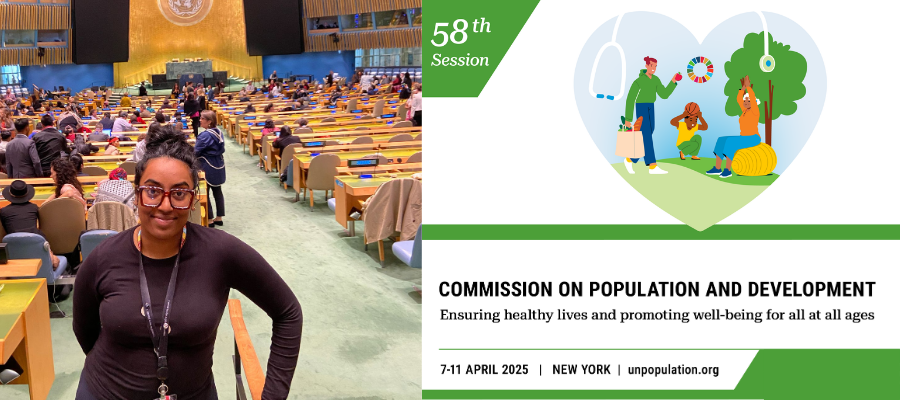
The 58th Commission on Population and Development, was a personal interest as it was an opportunity to primarily focus on this year’s theme: “Ensuring healthy lives and promoting well-being for all at all ages.” The commission was of special interest to me as it is linked with my university studies. Many discussions were more specific to maternal mortality and reproductive health.
Maternal Mortality has been decreasing over the last couple of decades, however preventable deaths are still prevalent. According to the WHO, teenagers and children are most vulnerable to avoidable maternal deaths. Teen pregnancies are quite harmful for not only the teen themselves, but also the child, families and mental health.
In order to reduce the amount of teen pregnancies, many countries have implemented stronger education based on reproductive health and provide more information and access to contraceptives. Laos, Thailand, Cambodia and Vietnam, have all displayed a great improvement in their education especially based on reproductive health. The average rate of maternal death has declined but continues to still impact society.
The Mekong countries shared the challenge with climate change and access to healthcare and education. With climate change, the Mekong countries are vulnerable to flooding and more extreme weather patterns. This has an impact on young girls specifically, attending school and are often prone to missing school.
Additionally, many ‘developing nations’ have limited healthcare training, facilities and resources. The Maldives, Fiji, Tuvalu, Nauru and Timor-Leste shared special scholarships for individuals to pursue a career in health. Budget allocations have also been increased, to ensure adequate training for midwives is provided. Some of these countries also now provide financial incentives to rural and remote areas, for health professionals to provide more accessible healthcare.
Although maternal mortality was discussed with great depth especially in primary care settings and education, Member States shared limited information based on gender-based (GBV) and domestic violence. Pregnant women are more vulnerable to be victims of GBV compared to non-pregnant women.
I asked the panelists if their healthcare training also covers GBV. Fiji responded by saying that it is important to increase funding for this to be covered further. However, there are no clear services available within the healthcare system for victims of GBV especially for women who are pregnant.
Pour plus d'informations, cliquez sur ICI.
Auteur: Jenalle Anthonypillai (Youth Representative IBVM – Loreto)


