
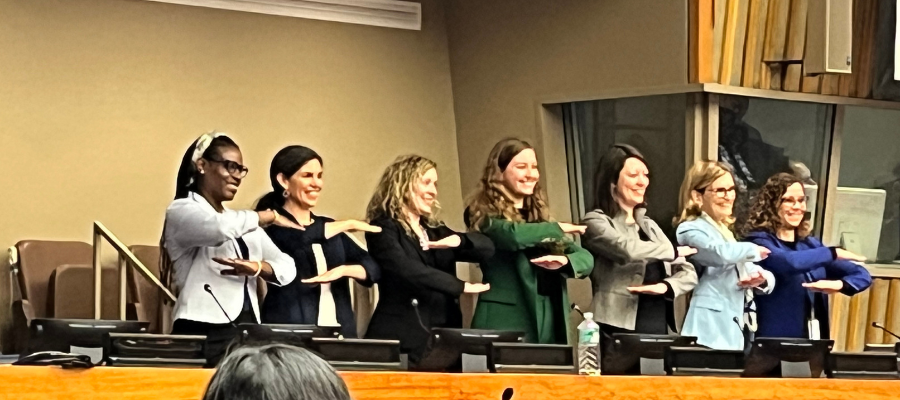
I was honoured to participate in the session ‘Story-telling for Transforming Patriarchy and Achieving Gender Equality’, a parallel event of CSW 70, organised by GenderWorks, a part of Gender Equity Reconciliation International. This was my first experience of a Gender Equity Reconciliation Workshop, and I found the session deeply insightful.
Gender Equity Reconciliation (GER) process is a facilitated, safe forum that brings women and men together to address deep-seated gender inequities, heal from negative gender conditioning, and foster mutual understanding. It primarily focuses on addressing the emotional, psychological and cultural roots of gender injustice. We were asked several questions to help us better understand how gender conditioning affects us in our daily lives, such as, ‘Have you ever felt unsafe travelling alone at night because of your gender?’ In this question, the differences in the experiences of men and women were clearly evident, prompting us to reflect on how genders that were created alike are subjected to such different treatment by society and face such different realities. There were other similar questions that were asked to show the influence that patriarchy and stereotypes can have on all human beings, irrespective of gender.
We were then divided into breakout rooms of three participants each and asked to share our thoughts on what we, as women (or men), had learnt from our mothers (fathers) or mother figures (father figures) that had significantly affected us, and whether we had accepted or rejected that conditioning. It was a deeply transformative experience to hear what the other members in my breakout room had gone through. One thing I particularly loved about how the session was conducted was the great attention to each individual’s privacy, which made us feel safe enough to share our thoughts freely. I, too, could share thoughts and reflections that had always been close to my heart, but I had never been able to voice them openly, for fear of being judged or, worse, simply dismissed. It was heartening to know that most of us rejected the gender conditioning that we had received from our parents- it showed that, slowly but steadily, we were making progress towards a world which would be a better place to live in for all human beings. We were also asked to reflect on our idea of a gender-neutral world. The fact that the elimination of gender-based violence turned out to be the first condition for our world to be gender neutral revealed a harsh reality of our world today. We also realised that breaking gender stereotypes, empowering all genders, and fostering mutual compassion and understanding are truly essential to achieving a gender-neutral world.
What stayed with me the most was not just the diversity of experiences shared, but the realisation that gender conditioning also shapes our thought processes and behaviours. I felt that recognising this was the first step towards changing it. I think this session brought together people of all genders to share challenging gender-related stories and experiences, and listen to one another with compassion. Most importantly, it enabled us to develop a vision of a gender-healed world and ways to create and achieve it. We recognised that achieving a lasting change requires taking time to build trust-based relationships between genders.
Autor: Shuchismita Adhikari, Youth Intern, India


