
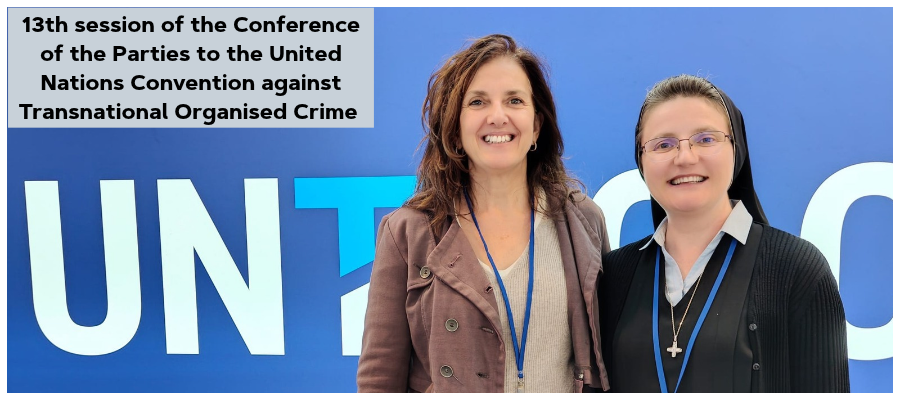
From 19 to 23 October, the city of Vienna hosted the 13th session of the Conference of the Parties to the United Nations Convention against Transnational Organised Crime (UNTOC COP13), an international gathering at which governments, United Nations agencies and civil society organisations came together to assess progress and challenges in the fight against transnational organised crime.
We had the opportunity to represent the Congregation of Jesus at the Conference and to bring our experience and commitment as an anti-trafficking network to this international forum for dialogue and decision-making.
This Convention (UNTOC), known as the Palermo Treaty, is one of the main international instruments for cooperation between countries in tackling criminal networks that operate across borders. The conferences, which periodically bring together the 195 signatory countries, provide an opportunity to review the implementation of the treaty and also to address new challenges.
On this occasion, it was emphasised throughout the debate that phenomena such as human trafficking, drug trafficking and the illegal exploitation of natural resources are increasingly interconnected and cannot be tackled in isolation. It is necessary to strengthen international cooperation, trace the money derived from criminal activities and ensure that political and legal responses translate into effective protection for the people and communities affected.
The voice of civil society: putting people at the centre
During the general debate, civil society organisations had the opportunity to speak and share our concerns and proposals with the delegations of the countries party to the Convention.
Among the organisations present was the Congregation of Jesus. In our statement, we emphasised the fundamental principle underpinning the global work of the anti-trafficking network: the need to place the dignity, rights, safety and decision-making capacity of victims and survivors at the centre. We also put forward five priorities: to address new forms of recruitment and exploitation facilitated by technology; to strengthen international cooperation; to protect women and girls from the structural factors that increase their vulnerability; to ensure the identification of victims, legal assistance and the principle of non-criminalisation; and to recognise survivors and civil society organisations as key partners.
Building networks to move forward together
One of the particularly significant aspects of this experience was being able to share it with other members of RENATE, the European network against human trafficking to which our organisation belongs. Among them were Brian O’Toole, from Ireland, and Adina Balan-CJ, from Romania.
Following her time in Rome, where she coordinated the JPIC Office of the Congregation of Jesus, Adina has returned to Romania and resumed her involvement with RENATE. Meeting in this international forum has been an opportunity to recognise the value of collaborative networks that link our work and strengthen a shared response to trafficking.
Taking part in the conference has helped us to reinforce our international commitments and to remember that these only take on true meaning when they translate into concrete changes in people’s lives.
From the Congregation of Jesus, we wish to continue contributing our experience, listening to those who live through these realities, and advocating for policies that protect people and leave no one behind.
Bringing our voice to the United Nations also means working towards a world in which every person can live with dignity, freedom and hope.
Autor: Marta Santos, JPIC Spain
This article originally appeared in the CJ Spain Conecta newsletter.


