On April 15-17 the Economic and Social Council Youth Forum was held. This is a space for young people from around the world to come and engage in conversations specifically based on the Sustainable Development Goals (SDGs) that will be the primary focus during the 2025 High-Level Political Forum (HLPF). These discussions at the ECOSOC Youth Forum will enable young people to advocate for the important conversations that will happen during HLPF. This year the SDGs that will be reviewed are: Good Health and Wellbeing (SDG 3), Gender Equality (SDG 5), Decent Work and Economic Growth (SDG 8), Life Below Water (SDG 14) and Partnerships for the Goals (SDG 17).
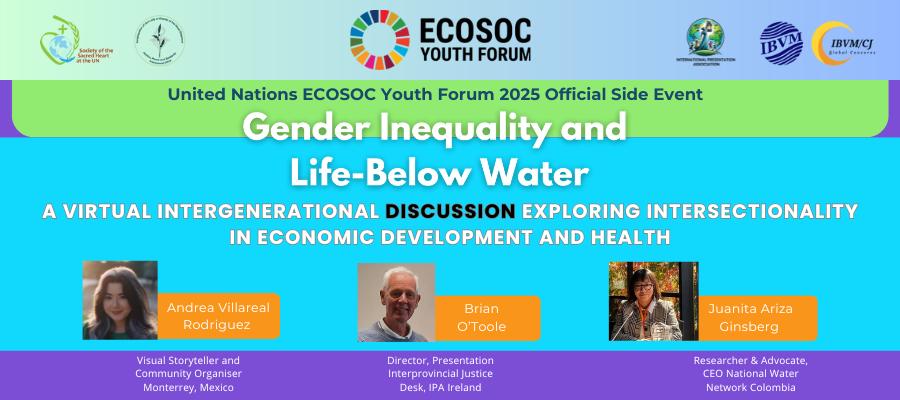
Over 3000 youth participants contributed to many discussions, including at side events. This year, we were accepted to host a virtual side event. Our event titled, “Gender Inequality and Life Below Water”, was a virtual panel discussion that specifically looked at how marine life, oceans, rivers and water impacts women and girls disproportionately in local economies and health.
We had three guest speakers from around the world with different experiences. Each speaker spoke about how life below water and gender inequality intersected through economies, health and how young partnerships can help overcome this issue.
Brian O’Toole emphasized that youth students are “heroes for our time” who bring the SDGs to life through action. He called for deeper intergenerational collaboration, stressing that youth must be genuinely listened to, not just included at the table. Action, he said, is the antidote to youth anxiety. Highlighting the role of Global Citizenship schools and the “Challenge to Change” project in Presentation Schools, he underscored the power of storytelling in empowering students to meaningfully engage with the SDGs.
Juanita Ariza Ginsberg called for a paradigm shift to protect biodiversity and ensure access to a healthy environment. She also emphasized youth involvement in data collection, supporting Indigenous communities, and recognizing water as both a national and international security issue.
Andrea Villareal Rodriquez shared that life below water includes not only oceans and coastal regions but also those in landlocked environments and sourcing water from rivers. She shared the powerful connection water has in her community, and that it is almost the lifeline for her city to survive. She shared her experience as a young person and also highlighted how generations taught her that life below water holds great history and power to Monterrey’s culture.
From the panelists’ experiences, we opened space for discussion among participants so that our panelists could also share their own experiences and interact directly with the panelists.
Breakout room – SDG 8
Gender-based pay gaps, women’s exclusion from property rights, and unpaid labour in fishing communities were discussed. In Liberia, women face abuse, lack of cold storage, and limited market access despite their key role in the fishing sector. In Zimbabwe, women farmers are trained in climate resilience, addressing environmental and gender challenges. Unbridled economic growth harms both women and the environment.
Breakout room – SDG 17
To overcome the climate crisis, multigenerational involvement is imperative. It is important to listen and come from a place of understanding. Simultaneously, it is important not to be afraid of having conversations with different generations.
Breakout Room – SDG 3
Participants noted the impact of marine pollution on women’s health, especially during pregnancy, and criticized its neglect in international treaties and the upcoming UN Ocean Conference, reinforcing the need for youth-driven change.
Watch our event HERE.


