
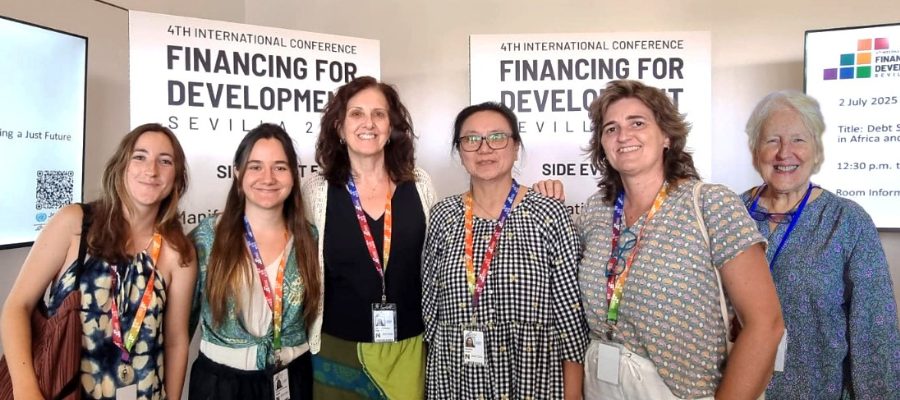
After months of preparation, we finally set off for Sevilla, Spain to participate in the Fourth International Conference on Financing for Development (FFD4). There, we were warmly received by the IBVM community of Castilleja, who welcomed us with generosity and kindness during days marked by intensity and oppressive heat. Having a place to rest, regain strength, and feel at home was truly a gift.
For one week, Sevilla became a global meeting point: 200 national delegations, 70 heads of state, and more than 12,000 representatives of governments, institutions, and civil society.
In the days leading up to the Conference, we joined various spaces for dialogue and expression: a vigil in the Cathedral, the Feminist Forum, the Civil Society Forum, and a symbolic march through the streets of Sevilla. We also hosted a roundtable discussion that gave us the opportunity to highlight the significance of this Conference and share the voice of the Mary Ward family.
It was a valuable opportunity to strengthen networks of solidarity with other organizations that, like us, believe in justice and dignity for all.
A Timely Conference in an Uncertain Era
FFD4 was a UN-led platform for dialogue, where States came together on equal footing to discuss how to finance more equitable and sustainable development. Key challenges addressed in the negotiations included:
- Financing the SDGs: Achieving the Sustainable Development Goals requires an estimated US$4 trillion annually. While this figure appears daunting, it represents only a fraction of global financial flows. What is needed is for governments to align public policies more closely with the SDGs, reform tax systems to make them fairer, and strengthen efforts against tax evasion.
- The Debt Crisis: Many countries cannot finance public policies through taxation alone and must rely on borrowing. Yet external debt has reached critical levels: over 3 billion people live in countries that spend more on debt service than on health or education. The unjust conditions under which much of this debt was incurred, combined with the Global North’s ecological debt, continue to entrench inequalities.
- Cuts in Official Development Assistance: In the past year, aid has been drastically reduced. Only four countries currently meet the international commitment of allocating 0.7% of GDP to unconditional development assistance.
Civil society—including representatives of the IBVM NGO and the CJ at the United Nations—amplified the voices of those most affected. Beyond the statistics, lived experience reveals the profound human cost of a global financial system that fails to place people first.
The broader context was not favorable: political tensions, armed conflicts, and a weakening commitment to multilateralism hindered progress. As negotiations advanced, many ambitious proposals were diluted, and ultimately the “Global North” imposed its vision. Nevertheless, despite the withdrawal of the United States, a consensus document was adopted: the Sevilla Commitment. While insufficient in the eyes of many, it represents a starting point for further progress.
What Echoed in Sevilla
Our participation in the Conference reaffirmed a profound conviction: another economic and social model is both possible and urgent. A model that places people and the planet at the center. One that embraces an ethic of care, solidarity, and shared responsibility among nations. One that guarantees the right to development for all. As was often repeated during the Conference: “You cannot change the world with the current rules; you have to change the rules.”
Organizations from the Global South, the Church, and civil society consistently put forward concrete, well-grounded proposals. Though absent from the final document, they remain essential to systemic transformation:
- Support for the UN Convention on International Tax Cooperation
- Promotion of a Convention for International Development Cooperation
- Creation of a new, transparent, and binding international debt framework under UN leadership.
The Sevilla Commitment: Only the Beginning
We left Sevilla with open eyes, enriched by new insights and carried with us the faces and voices of those who, like us, continue to dream of a more just and sustainable world. And we also leave with renewed responsibility, for this is not the end.
Upcoming milestones will soon demand our commitment and perspective:
- In November, the Second World Summit on Social Development (Doha, Qatar)
- Shortly after, COP30 on Climate (Belém, Brazil).
Author: Marta Santos Romero is the IBVM/CJ Spain Province UN Representative. This article was first published in Conecta July 2025.
Photo: FfD4 IBVM/CJ delegates from L to R – María Pérez Manzano, Irene Cebrián de Arancibia, Marta Santos Romero, María Llinás Ramos and Cecilia O’Dwyer ibvm


