
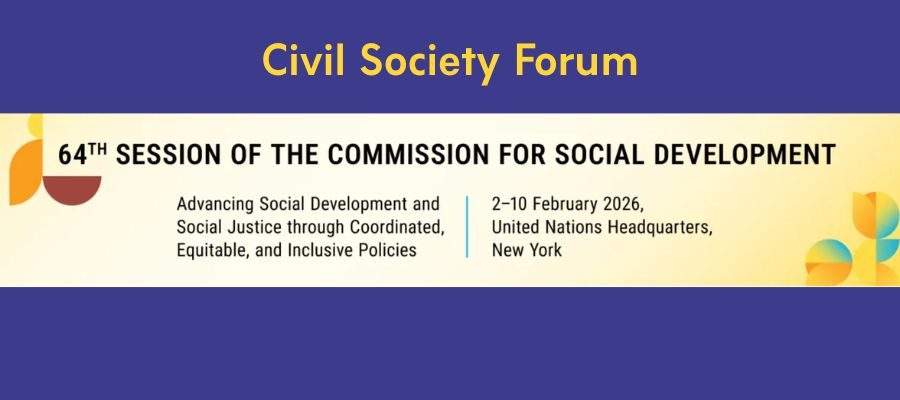
The 64th session of the Commission for Social Development took place February 2-9, 2026. The Civil Society Forum was held on Friday, February 6, 2026. Global leaders united to bring out solutions for poverty, unemployment, and inequality (United Nations, 2025). The Doha Political Declaration, that was recently adopted at the Second World Summit of Social Development reaffirmed the Copenhagen Declaration, which had established three global commitments: Poverty eradication, Full and Productive Employment, and Social Inclusion. Civil Society refers to the groups or organizations outside the government or United Nations. As noted by Christina Hayovyshyn, Civil Society brings lived situations of people to global debate. It brings lived experiences of people closer to world discourse where the needs of communities are heard in the policies. Through collaboration among the United Nations, government, and civil society, social development agendas should be viewed as an investment rather than an expense.
Throughout the session, although some statements sounded repetitive, speakers emphasized the urgent need to take action that can be measured in each country. Notably, Jonathan Passmoor’s insights showed his critical thinking and how he used past events to elaborate his point. He looked back at the old Copenhagen Declaration and compared it with the new Doha Declaration. He emphasized that the interests of people sit at the heart of United Nations and that new Doha Declaration does not abandon the old Copenhagen Declaration, instead just updates them for contemporary challenges. In conclusion, the CSocD64 opening session focused on making global commitments happen. Civil society is essential in taking into the table the experiences of people and making the policies inclusive and effective. Through viewing social development as an investment and not an expense, it is possible to coordinate efforts to make meaningful and lasting changes to communities all over the globe.
Author: Tejaswi Siwakoti, Youth Intern, India
***
On February 6, 2026, the United Nations Department of Economic and Social Affairs (UNDESA) and the NGO Committee on Social Development jointly hosted the Civil Society Forum at the UN Headquarters in New York. The attendees included UNDESA and other UN body representatives, member state representatives and several civil society representatives from various regions, both in person and online.
The forum featured four panels, each of which were crucial in their discussion of concerns relating to the theme. The opening panel was moderated by Ms. Li Zou, International Director of the Centre for Social Development at Washington University. Speakers included His Excellency Mr. Lok Bahadur Thapa, the President of the Economic and Social Council, Her Excellency Khrystyna Hayovyshyn, Deputy Permanent Representative of Ukraine to the UN and current chair of the CSocD bureau, Ms. Bjørg Sandkjær, Assistant Secretary-General for Policy Coordination in the UN DESA and Ms. Gillian D’Souza Nazareth, Chair of the UN NGO Committee on Social Development. The opening panel focused mainly on the need for government accountability in the implementation of the Copenhagen and Doha Declarations, as well as civil society’s role in demanding inclusion and concrete action.
The first panel, moderated by Ms. Maryann Dantuono, Main Representative of the International Association of Charities to the UN, aimed to discuss the theme, ‘Advancing inclusive pathways to poverty eradication’. Mr. Youssouf Aden Moussa, Counsellor of the Mission of Djibouti to the UN spoke about the initiatives launched to combat poverty in Djibouti, especially focusing on women and girls. Mr. Jonathan David Passmoor, Counsellor of Political Affairs for the Mission of South Africa to the UN shared the ways in which South Africa has centred the Doha Declaration and universal social protection in its constitutional framework as well as its development plans. Ms. Masumi Ono, Chief of Social Inclusion and Participation branch at UNDESA highlighted the need for investment in long term care, especially for marginalised groups. Ms. Maryann Broxton of ATD Fourth World brought forward some key statistics on poverty and its disproportionate impact on women and girls to highlight the need for accountability.
The second panel, moderated by Ms. Alexia Gaube of the NGO Committee for Social Development, dealt with the theme, ‘Decent work as a foundation for social inclusion and cohesive societies’. Ms. Cynthia Samuel-Olonjuwon, Special Representative of the International Labour Organisation to the UN, discussed the need for collaboration with key stakeholders, especially civil society, to take a multidimensional approach to the problem. Ms. Pamela Morgan, UN Committee Chair of Zonta International, discussed the repercussions of AI in the labour market, especially its impact on women and girls. Ms. Paola Simonetti, Director of the Equality Department at the International Trade Union Confederation spoke about the living wage as an essential element to decent work.
The closing panel, moderated by Ms. Cecilie Kern, Main Representative of Mercy International Association, discussed concrete implementation of the Doha and Copenhagen declarations. Panelists included Mr. Stefano Guerra of the Permanent Mission of Portugal to the UN and current Vice Chair of the CSocD, Ms. Merle Rutz, Policy Analyst at Friedrich-Ebert-Stiftung and Mr. Henry Ramirez Soler, Vice Chair of the NGO Committee for Social Development. The contributions of organisations such as Cáritas Portuguesa, Friedrich-Ebert-Stiftung and the European Anti-Poverty Network were discussed and applauded.
Certain valuable interventions by representatives of organisations such as Daughters of Charity International, Make Mothers Matter and Qatar Foundation for social work raised important points about the care economy, inclusion, artificial intelligence and the educational gaps. All questions were addressed by the esteemed panelists, and civil society representatives from diverse backgrounds were given the opportunity to engage in meaningful dialogue with UN and member state representatives. The forum concluded with an urgent call for action to address the cause of social development before 2030 for a more equitable, inclusive and just world for all.
Author: Daksha Singh, Youth Intern, India


