
The 81st session of the UN General Assembly opened on 8 September 2026 under the theme “Restoring trust, managing transformation: a United Nations that delivers for all.”
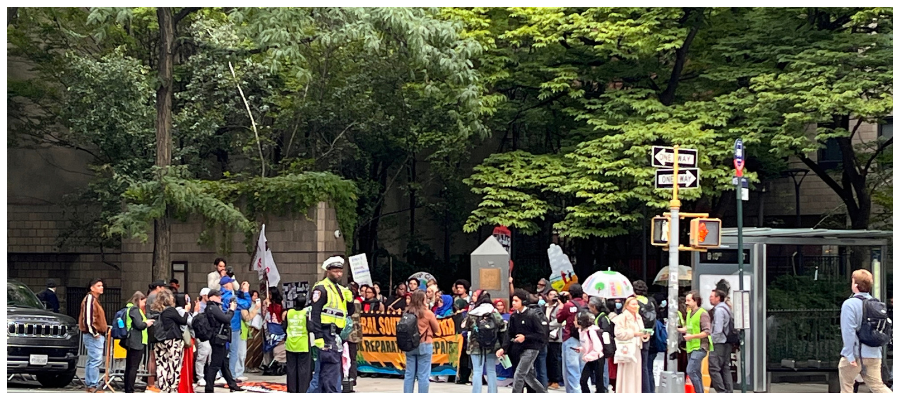
During the high-level week (22-28 September), world leaders and senior ministers gathered to speak to the world through the general debate. On the first day of the general debate, the scale of security surrounding UN Headquarters was striking. Across the street, protesters in Dag Hammarskjöld Plaza voiced a simple plea: an effective United Nations that represents and responds to the needs of people.
Over six days, 194 delegations took part, including 113 heads of state and government, under the theme of restoring trust. Artificial intelligence was a major feature of the conversation, but the headlining news of nearly every speech were the entrenched conflicts in Israel-Gaza, Iran, and Russia-Ukraine.
In his final General Debate address, Secretary-General António Guterres named four global tests: peace, inequality, climate change and artificial intelligence. These four tests are challenging and shaping our world, and world leaders must respond. He also repeated the UN Charter’s logic: no peace without development, no development without peace, and neither without human rights. Catholic social teaching agrees. Pope Paul VI called development the new name for peace, and each pillar of the UN Charter rests on the dignity of the human person.
On issues of peace and security, several nations warned that nuclear arsenals keep humanity near annihilation, while President of Zelensky of Ukraine described the human toll of a war now in its fifth year. On human rights, Guterres insisted that children must never become test subjects for unregulated technology, and the President of Kenya spoke of children who learn the sound of gunfire before the safety of peace. On sustainable development, the President of Ecuador urged that success be measured by lives of dignity, decent work and the eradication of poverty.
Guterres leaves office on December 31 after a decade in office. Many heads of state paid tribute to him, saying his example will inspire young people to serve the world. His successor will take office on 1 January 2027, and pressure is mounting for the UN to be led by a woman for the first time.
When the week concluded, there was a palpable sense of heaviness. The weight of conflict and violence and poverty was tangible. It was tempting to walk away from the high-level week discouraged and disillusioned. As Christians, however, we are urged to neither look away nor to despair. This is a kairos moment, a graced moment where we see the world starkly, assess reality frankly, and commit to rebuild trust and international cooperation. As an NGO, we commit to continuing to witness to the suffering of the world, to offer glimpses of hope, to build just relationships and to keep building ‘a civilization of love’ (Pope Leo, Magnifica Humanitas).
The General Assembly President reminded leaders that this is only the beginning of the 81st session. May it also be the beginning of a more hopeful chapter for peace.
Author: Sarah Rudolph, CJ


