
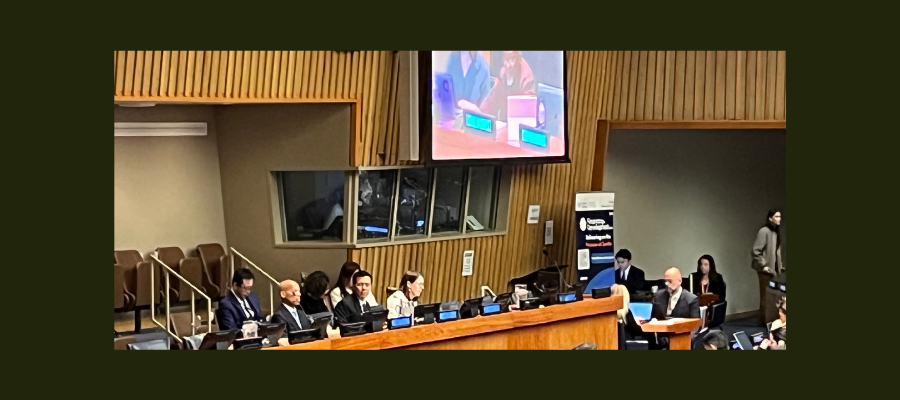
On the 20th of April, the 1st Meeting of the 2026 ECOSOC Forum on Financing for Development took place. This opening meeting consisted of a panel, as well as a collection of country representatives, diplomats and civil society. The meeting was opened by António Guterres, the current UN Secretary-General. He stated that this forum was the first major test of whether countries would act on Sevilla promises. This Sevilla agreement was formed at the Fourth International Conference on Financing for Development in Sevilla, Spain during June/July 2025, and was frequently mentioned in this opening session. Guterres mentioned that in the time since this meeting in Sevilla, nations remained trapped by debt, had weak economic growth and expensive borrowing costs. The financial blows of the current global conflicts as well as climate change impacting food security, water quality, energy availability and production, as well as unstable leadership were also discussed as key issues. The purpose of the 2026 ECOSOC Forum on Financing for Development seemed to be to discuss the implementation of urgent reform of the international financial structures, as it was said that financial development was the key to peace and stability, but required commitment from countries, especially those willing to or who had already commited to aiding other countries in worse financial positions.
UN General Assembly President Annalena Baerbock called for direct action from the group. The UN is sometimes critiqued for achieving discourse instead of concrete action in relation to global issues, either because they do not have the power or because it is easier for countries to discuss the same or arising issues than it is to directly solve them. Baerbock affirmed, especially to those who had attended the Conference on Financing for Development in Sevilla, that…
“…the world does not need us to rehash the same problems, nor does it need us to repeat promises already made and certainly not to litigate them, reopen debates, we just find a compromise and a consensus on less than a year ago in civilia. What it needs now is action. Full stop. We need to deliver on the promises already made, not come up with new ones, not renegotiate texts, and not raise hopes only to disappoint. Because this goes also to the credibility of this institution in shaky times. And thankfully, there are more and more solutions being put forward to make our promises a reality.”
It was promising to see this forum commence with such a forceful call to actionable results from the dialogue that would take place over the following days. It was argued no country can achieve sustainable development alone and that it was the key to security, peace and dignity. It was the hope that this forum would be a successful collaboration of countries towards economic action development deliverables.
So what did the Sevilla conference commitments set out to do?
In a statement made on the press release from this conference, “with five years left to achieve the SDGs” the commitments centre around “three fronts” as listed below…
- Catalyzing investment at scale for sustainable development
- Addressing the debt and development crisis
- Reforming the international financial architecture
Their principle goal was reduce the approximate annual 4 trillion dollar financing gap for SDG development. Annually, the SDGs require approximately 5 trillion dollars worth of progress until 2030, but with inflation and increasing costs this figure is increasing, placing a larger burden on financially struggling countries. They also pushed ideas of increasing availability of debt swaps for low to middle income countries, increasing the capability of development banks, promotion of fairer tax systems, specific financial support for developing countries particularly island countries and more.
To see a summary on these initiatives, click on this link…
https://www.un.org/sustainabledevelopment/blog/2025/07/ffd4-closing-press-release/
To read the commitments in full, click on this link…
Other key speakers in this opening session were…
– The International Monetary Fund’s Deputy Managing Director
– World Bank Group Representative
– Amina Mohammed, the UN Deputy Secretary-General
– Country representatives
– Civil society representatives
I was particularly struck by the civil society representative speaking on behalf of Children and Youth International and the Financing for Development Children. She made the point that last year, 3 trillion dollars was “mobilised… in a matter of weeks for war and military, leading to conflicts and genocide, especially of children and young women. But the 4 trillion annual SDG financing gap mentioned in paragraph six of the outcome document remains unmet.” Surely this is a sign that the global financial mindset needs resetting. The financial priorities of the world are currently not seeking to invest in SDG nor global financial development, but in more destructive forced like conflict.
It was interesting to hear from this youth representative who was demanding the voices of youths be better listened to and included in these financial conversations. This was particularly pertinent in light of the ECOSOC Youth Forum which occurred the previous week. It was discussed here that “sustainable financing is indispensable to unlocking youth potential” but also that youth delegates and advocates have many ideas which should be considered in making concrete progress towards the SDGs.
This was an interesting opening session overall.
Autor: Clare Tuckwell, Youth Intern, Australia


