
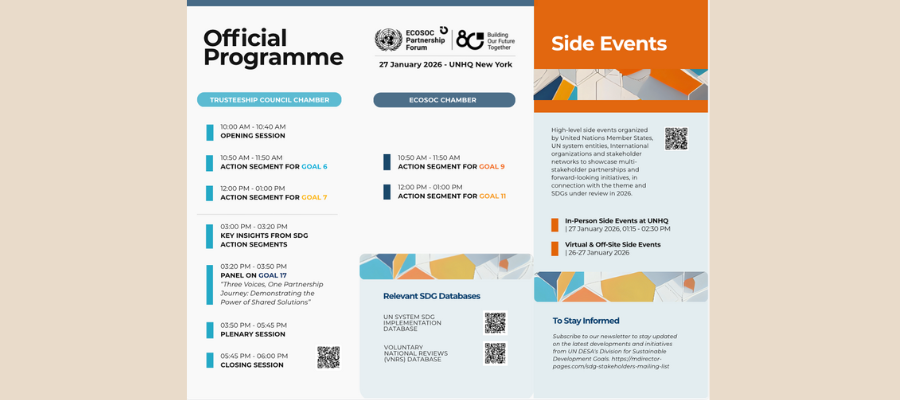
On 27 January, the Economic and Social Council (ECOSOC) held its annual Partnership Forum under the theme “Transformative, equitable, innovative and coordinated actions for the 2030 Agenda and its SDGs for a sustainable future for all”. The Forum places a special emphasis on the Sustainable Development Goals (SDGs) under in-depth review at the 2026 High-Level Political Forum on Sustainable Development (HLPF): Goal 6 (Clean Water and Sanitation), Goal 7 (Affordable and Clean Energy), Goal 9 (Industry Innovation and Infrastructure), Goal 11 (Sustainable Cities and Communities), and Goal 17 (Partnerships for the Goals). I attended the Forum with the purpose of making connections with the SDGs under review to the work undertaken by the global Congregation of Jesus, attentive to opportunities for informed advocacy and collaboration with Member States, UN departments and agencies, and other civil society actors.
Sessions focused on concrete actions undertaken in each of goals, with country-specific examples. For instance, in the Democratic Republic of the Congo, one speaker noted the complex interplay between climate vulnerability, water scarcity, environmental degradation and poverty. Climate resilience occurs through sustainable water access. Solutions include not only the digging of holes and wells for water access but accompanying these actions with practices that support hygiene and sanitation needs and the maintenance of the water supply. Speakers commented on the essential collaboration of the private sector and civil society to ensure sustainability and resilience. Private sector partners contribute tools, expertise, and innovation, especially in clean energy solutions and are considered co-implementers of solutions alongside civil society and local communities.
Speakers exploring responses to achieve SDG 11: Sustainable Cities and Communities considered issues of disaster risk management, the role and empowerment of municipal governments, the needs of older persons when designing age-friendly cities, and an integral urban fabric that cherishes heritage and culture.
In the afternoon, I attended a side event hosted by the Permanent Missions of Spain, Australia, Belgium, and Canada in partnership with the Center for International Cooperation at New York University. Entitled The UN80 Process, the repositioning of the UN Development System and SDG 17: strengthening Stakeholder Engagement, speakers from a broad range of UN departments and agencies spoke about the how the UN80 reform initiative and UN Development System reform will shape the next generation of development cooperation.
As one speaker noted, “If you’re not a Member State, it can be difficult to know how you fit in” to the UN system. This was echoed by the civil society representative who provided recommendations for deepening engagement with civil society in the reform processes, such as the creation of an advisory group of stakeholders, massive online consultations modeled after ‘The World We Want’ initiative leading up to SDGs, and engaging UN resident coordinators to convene dialogue at the national level. Above all, it was argued that reform should lead not simply to further consultation with civil society but to a UN development system that is built around co-design and co-delivery and empowers community-led development processes.
The Forum ended with an interactive session and a call to mobilize resources (human, knowledge, financial) to further action on the SDGs.
Author: Sarah Rudolph, CJ


