
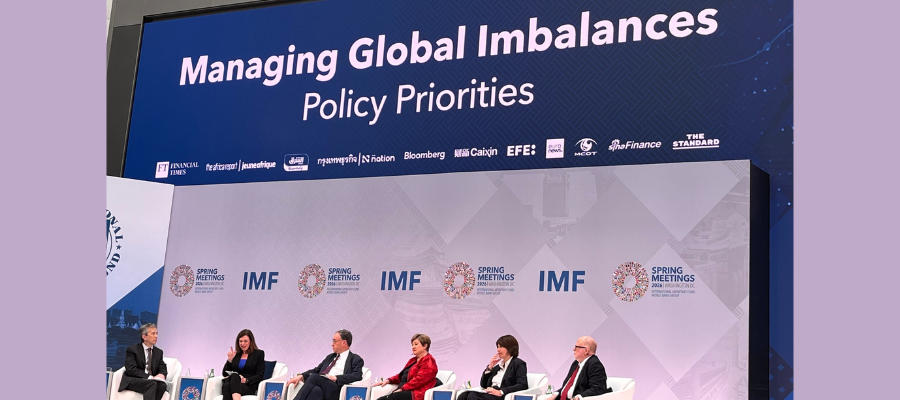
Washington, D.C. | April 13–15, 2026
I attended the first three days (April 13-15) of the 2026 Spring Meetings of the International Monetary Fund (IMF) and World Bank Group in Washington, D.C. to learn about global fiscal policy. As an NGO we participate in the UN NGO Committee on Financing for Development, which draws on the work of the World Bank and IMF in its policy advocacy.
The spring meetings opened against a backdrop of overlapping global crises — ongoing war in the Middle East (and other regions of the world), a severe oil supply shock, rising debt burdens, and deepening questions about the legitimacy of multilateral institutions. Under the World Bank’s theme “Building Prosperity Through Policy,” the meetings drew together finance ministers, central bank governors, civil society, and development partners to grapple with an increasingly fractured world order.
War reconstruction dominated the Civil Society Policy Forum event on April 14. A panel convened by Oxfam International examined how reconstruction in Gaza, Lebanon, and Syria is being shaped by political and security agendas rather than development logic at the grassroots level. Speakers from Carnegie, the Arab Reform Initiative, and the World Bank itself warned that plans for Gaza risk embedding what one speaker described as ‘counter-insurgency doctrine’ and ‘disaster capitalism’, that is, prioritising external investment and control over the agency of the Palestinian people. The World Bank’s role as a limited trustee of the Gaza Reconstruction and Development Fund drew pointed scrutiny, with civil society raising concerns that its fiduciary standards fall short of the institution’s own norms elsewhere. Syria’s reconstruction path also featured, with warnings against shock-therapy economics and top-down governance that sidelines civil society.
Indigenous peoples’ rights also featured prominently in a side event on April 14, with advocates pressing for stronger free, prior, and informed consent (FPIC) standards in IFC project financing, drawing on lessons from the Philippines, Canada, and beyond.
A second major thread was debt. The G-24 press briefing on April 15 underscored that developing countries are experiencing a net outflow of resources: debt servicing in 2024 alone outpaced the combined value of overseas development assistance and foreign direct investment. With global interest payments rising sharply and ODA shrinking, the G-24 called on multilateral lenders to provide additional liquidity and lower borrowing costs. A side event on debt accountability spotlighted the role of parliaments in oversight, highlighting Uganda’s debt-to-GDP ratio edging past the recommended 50 per cent threshold as a cautionary example.
On April 15, the World Bank launched Water Forward, a new global initiative to strengthen water security and promote water as a driver of economic growth. A side event on how to influence fiscal policy highlighted survey evidence from 32 countries that demonstrates finance ministry officials prioritise education, health, and social protection but often deprioritise climate and gender. Windows of opportunity exist for civil society to influence government budgetary spending in these areas, with opportunities for greater advocacy regarding climate and gender.
As the week unfolded, a broader anxiety permeated the halls: what Atlantic Council analysts called “shock fatigue.” With crises perpetually crowding out long-term agendas on debt, climate, and artificial intelligence, delegates arrived asking not just what solutions the institutions could offer, but whether the institutions themselves remain fit for purpose.
Autor: Sarah Rudolph, CJ
Sources: Bretton Woods Project; Atlantic Council; IMF G-24 Press Briefing; World Bank Live; author’s notes


