
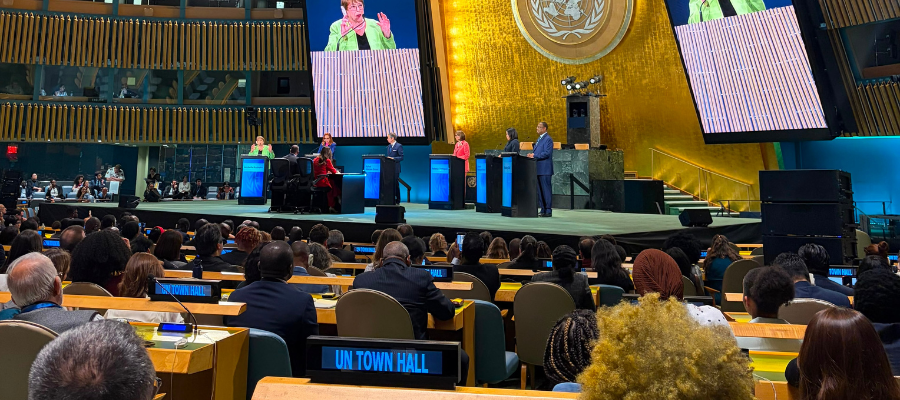
On July 23rd, six candidates for the position of the next UN Secretary-General took the stage together for a rare public Town Hall, livestreamed though Bloomberg News and UN WebTV for the world to watch. UN General Assembly President Annalena Baerbock opened the event by calling the role of the Secretary-General “the face and custodian of the house of humanity”.
The candidates — Michelle Bachelet (Chile), María Fernanda Espinosa (Ecuador), Rafael Grossi (Argentina), Rebeca Grynspan (Costa Rica), Carolyn Rodrigues-Birkett (Guyana), and Macky Sall (Senegal) — responded to probing questions: how to act when the Security Council is paralyzed by veto, how to rebuild trust with the 72 Member States behind on their dues, how to keep climate, human rights, and peace from being treated as separate silos, how AI should be governed, and what it will take to restore the credibility of multilateralism when conflicts in Israel and Gaza, Russia and Ukraine, and other crises continue to test it. (Learn about the candidates aquí.)
Some commonalities emerged through the dialogue. Trust was the word spoken most often. Trust between the UN Secretariat and Member States, trust between the UN and the people it serves, trust that has eroded as conflicts multiply and an institution built by previous generations responding to the Second World War struggles to answer to a world where nearly half of humanity is under 30 years of age. Several candidates spoke plainly about the liquidity crisis not as a technical budget problem but as a symptom of that deeper trust deficit. There was a much-needed reality check, too, concerning the limits of the Secretary-General’s authority: the office holds influence rather than power, and its tools are moral authority, presence, mediation, and the discipline to keep trying to find solutions even when the Security Council is stuck.
As a Catholic faith-based NGO, our advocacy is grounded in the Catholic social justice tradition. Of great concern are the dignity and rights of all persons, especially those “furthest behind” or on the margins of society, and care for our planet. For us and for other faith-based organizations, this Town Hall was a hopeful sign in troubling times. The language of dignity, solidarity, and care for the excluded, repeated by many candidates, speaks to the heart of our mission. A “leaner but stronger” UN, several argued, is not a contradiction. The UN can become “fit for purpose” to serve those most in need better as it employs the moral courage needed to uphold the values and principles its Charter was built upon.
As fiscal constraint tightens and geopolitical fragmentation deepens, the next Secretary-General will need more than administrative skill. She or he will need the humility to listen, the courage to speak truth to power, and an unshakable belief that the “house of humanity” is still worth building together.
As a member of the Justice Coalition of Religious, our organization has helped to shape this Statement of Values for the Next Secretary-General, and as a member of the NGO Committee for Social Development, we have helped shape this Vision for the Secretary General. These statements have been shared with all Member States and with the Office of the President of the General Assembly and we continue to advocate for the values we wish to see manifested in the next leader of the “house of humanity.”
Article 97 of the UN Charter states that “The Secretary-General shall be appointed by the General Assembly upon the recommendation of the Security Council.” This means that the next UN Secretary-General is selected by the Security Council with at least nine affirmative votes and no vetoes from permanent members, and then is appointed by a majority vote in the General Assembly. Results of the first straw poll of the Security Council on the candidates indicates a slight preference for Rebecca Grynspan at this time. The selection process continues with the next interactive dialogue with the candidates to be held on August 19th.
Autor: Sarah Rudolph, CJ


