
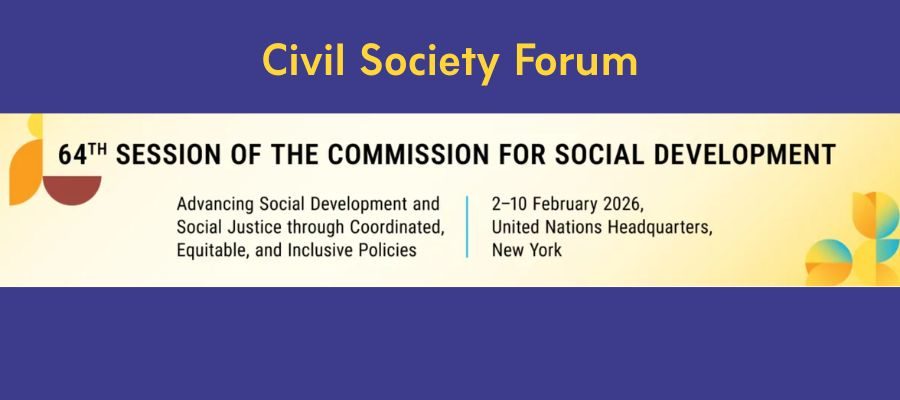
The 64th session of the Commission for Social Development marked the adoption of significant resolutions aimed at advancing social development and addressing key global challenges. The closing session began with the adoption of the priority theme for the 65th session, “Strengthening social development through intergenerational approaches for achieving sustainable development and the implementation of the Copenhagen and Doha commitments towards 2030 and beyond”. This theme was seen as a reflection of the shared commitment to fulfilling goals set out in the Copenhagen and Doha Declarations and the 2030 Agenda for Sustainable Development.
The first key action of the closing session was the adoption of the draft decision regarding the priority theme for the 65th session, which was submitted by the Vice Chair, Mr Stefano Guerra of Portugal. The Commission confirmed that the draft had no programme budget implications and adopted it with no objection. Paraguay made a statement regarding national policies on social development, gender equality, and the importance of aligning social policies with the national legal framework and emphasized the country’s commitment to non-discrimination and gender equality under its national laws, while Israel raised concerns over the inclusion of the term “right to development” in the text.
Then the commission moved to consider the draft resolutions on the social dimension of the New Partnership for Africa’s Development and the advancement of social justice. Uruguay introduced a resolution on the social dimension of the New Partnership for Africa’s Development, highlighting the continued need to strengthen economic, social, and human resource development in Africa. The Group of 77 and China advocated for the fulfilment of the commitments made in the Copenhagen Program of Action and expressed appreciation for the technical updates in the draft resolution, which reflected recent international developments, including the integration of the African Union’s Agenda 2063.
Turkey expressed support for strengthening Africa’s technological and scientific capacities, especially through the UN Technology Bank for the Least Developed Countries (LDCs). Russia with the Republic of Iran, offered a statement of interpretation regarding the use of the term ”gender” and its application within their respective legal and cultural contexts. Iran focused their commitment to social justice but stated that any interpretation of the gender-related concept must align with the national legal frameworks, with Russia stating that the term “gender” stresses its biological interpretation and its focus on equality between men and women.
The session was followed by several important statements on the issue of the multiple forms of discrimination. Switzerland, representing a group of countries including Brazil, Canada, and the United Kingdom, strongly advocated for the inclusion of the concept of multiple and intersecting forms of discrimination (MIFD) in the resolution. The African Group, led by Liberia and Mali, expressed concern over the omission of the right to development and Rio Declaration principles in the draft resolutions, emphasizing the need for policies that promote technology transfer and address Africa’s poverty and inequality.
The session proceeded with collaboration, adopting resolutions focused on poverty eradication, social protection, decent work, and empowerment of marginalized groups. Emphasizing the need for coordinated policies across governments, the session also highlighted addressing social inequalities, particularly for vulnerable populations like children, youth, older persons, and persons with disabilities. A key outcome was recognizing the role of international cooperation in supporting social development, with delegates noting challenges like armed conflicts, fiscal constraints, and debt burdens that hinder effective social policies. The session stressed the importance of multilateralism, the United Nations’ role in global coordination, and the need for predictable financial support for social investment.
As the 64th session ended, Mr Stefano Guerra of Portugal was elected chair for the 65th session, with Mr Abs Tajik of Iran and Mr Shahriar Kjev of Azerbaijan as vice-chairs. The Bureau was tasked with ensuring continuity and preparing the next session’s agenda. The draft report, detailing deliberations and decisions, was adopted and entrusted to the Rapporteur for finalization. In his closing remarks, the outgoing chair emphasized collective action, cooperation, and shared responsibility among member states to address global challenges, highlighting the need for political will, effective partnerships, and adequate financing to achieve tangible outcomes.
The session concluded on a positive note, with a strong commitment from all delegates to continue working towards the achievement of the 2030 Agenda for Sustainable Development. The 65th session was officially opened immediately following the closure of the 64th session, and the first order of business was the election of the new chair and vice-chairs. With a renewed sense of purpose and determination, the Commission looks ahead to furthering its mandate of advancing social development, social justice, and inclusive growth for all.
Autor: Ruby Thapaliya, Youth Intern, Nepal


