
The 2026 commemoration of International Women’s Day at the United Nations General Assembly marked a critical turning point in global advocacy, moving away from symbolic celebration toward a demand for structural accountability. Opening the session, Emmy Award-winning journalist and activist Emmy Peruana addressed the “quiet erosion” of rights that has left many young women questioning the reality of the progress they were promised. She delivered a poignant critique of the international community’s reliance on female “resilience,” arguing that this trait is often a survival mechanism developed only when formal justice systems fail. Peruana’s opening served as a reminder that the cost of “pushing back” against inequality has become unsustainably high for many, and that the global crossroads we currently face will be defined by whether leaders choose to close the gap between promised rights and the actual justice women experience in their daily lives.
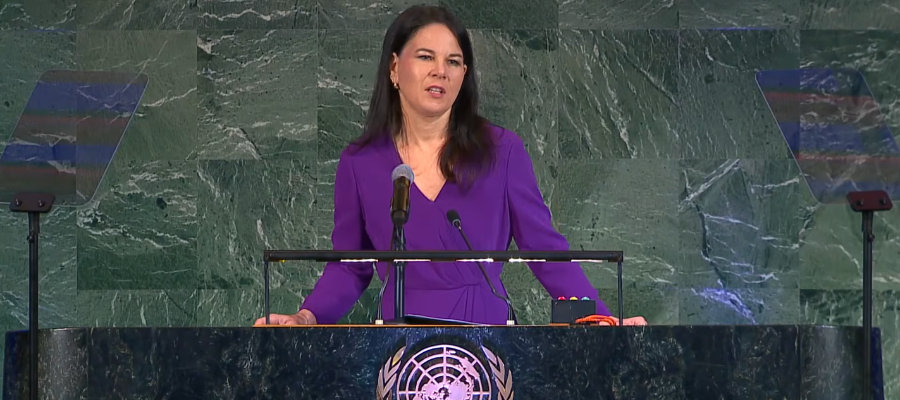
Her Excellency Annalena Baerbock provided a stirring defence of women’s leadership, specifically targeting the double standards and “backlash” that female leaders face in the modern political landscape. She urged a global reclamation of the phrase “like a woman,” reframing it as a badge of power rather than a pejorative. By invoking the history of Hansa Mehta—the Indian reformer who ensured the Universal Declaration of Human Rights affirmed the equality of “all human beings” rather than just “men” Baerbock established that gender equality is embedded in the very DNA of the United Nations. She issued a direct challenge to those who dismiss reproductive rights or gender-sensitive language as “woke,” asserting that these are fundamental human rights that have been fought for over eight decades. Her address concluded with a call for justice that reaches every corner of the globe, from the newsrooms and boardrooms of developed nations to the restricted lives of women in Afghanistan.
The institutional voice of the United Nations, represented by Earle Courtney Rattray and a video address from Secretary-General António Guterres, underscored that gender equality is not merely a moral imperative but a functional necessity for global stability. They highlighted that when women participate in peace negotiations, agreements are more durable, and when they lead in government, climate-friendly policies are more likely to be enacted. However, the Secretary-General warned that progress is neither automatic nor irreversible, noting that women still hold only a fraction of the legal rights afforded to men worldwide. Sima Bahous, Executive Director of UN Women, expanded on this by defining justice as the “non-negotiable foundation” of all rights. She noted that no country has yet achieved full legal equality and called for a radical overhaul of justice systems to ensure they are appropriately financed, data-driven, and capable of protecting survivors of violence in both physical and digital spaces.
In one of the most emotionally charged segments of the day, Nobel Peace Prize laureate Malala Yousafzai stood before the General Assembly to express her “heartbreak” over the worsening state of women’s rights globally. Thirteen years after her first speech in the hall, Malala condemned the “selective justice” that ignores the humanity of children and women in conflict zones such as Gaza and Iran. She reserved her strongest words for the situation in Afghanistan, which she characterised as a calculated system of segregation and domination. Malala made a historic plea for the international community to codify “gender apartheid” as a crime under international law. She argued that Afghan women are not seeking to be “saved” through military intervention, but are instead demanding legal recognition of their oppression so that the long process of international accountability can begin. Her message was clear: speeches alone are insufficient; only law and political courage can offer true protection to the world’s girls.
Crucially, the testimony of Sumbul Raja provided a poignant ontological dimension to this struggle, illustrating how artistic expression—specifically music—serves as a primary target of erasure in regimes of domination. By framing her continued education and musical practice as an act of “undisguised defiance,” Raja elevated the conversation from abstract legalism to the visceral reality of cultural agency. Her “global call to action” served as a reminder that the erosion of progress begins with the silencing of a single voice; therefore, the protection of a girl’s right to learn and create is not merely a social service, but a fundamental defence of human dignity.
The event was punctuated by powerful cultural contributions from Michelle Williams and Anne Hathaway, who used their platforms to bridge the gap between high-level policy and lived experience. Williams’ performance of “Fearless” served as an anthem for the day, emphasising that the strength of a woman’s lineage must be celebrated and encouraged rather than feared. Anne Hathaway, a UN Women Goodwill Ambassador, acknowledged the “thorny” nature of celebrating in a world that remains unsafe for women, specifically citing the bravery of survivors like Gisèle Pelicot and Virginia Giuffre. She argued that celebration itself is a form of defiance, a refusal to accommodate injustice. The commemoration closed with a final call to action from H.E. Maritza Chan Valverde, Chair of the 70th Session of the Commission on the Status of Women, who reminded the delegates that their success would be judged not by their words in the hall, but by their willingness to exert the political will necessary to transform aspirations into reality for every woman and girl.
Autor: Ruby Thapaliya, Youth Intern, Nepal
***
Just before the official opening of the CSW70, the UN held its International Women’s Day (IWD) event under the theme ‘Rights. Justice. Action. For ALL Women and Girls’.
While the UN Secretary-General was not in physical attendance at this event due to needing to prepare for the opening of the CSW70 occurring on the same day, their written statement was read out to the attendees. In a world where conflict is rampant, violence against women is prevalent and political regimes continue to place often violent and limiting restrictions on women’s rights, the Secretary-General emphasised the importance of IWD and CSW70. Their comments on how ‘progress [on achieving gender equality and women’s rights globally] is neither automatic nor irreversible’ but is something to be ‘defended… renewed and accelerated’ were echoed in other speaker’s presentations. Many noted backslidings in women’s autonomy and freedom which need to continue to be fought against. As two of the speakers were from Afghanistan, particular focus was placed on the experience of Afghan women under the Taliban’s regain of control of the country and their forceful pressure placed on diminishing women’s liberty since 2021.
See the extract below from Malala Yousafzai’s speech for more context on this…
‘For nearly five years now, the Taliban have been erasing women and girls from public life, and the world has responded by looking away or by excusing the abuses of the Taliban under the banners of culture or religion. This is not culture. It is not religion. It is a system of segregation and domination. We must call the regime in Afghanistan by its true name, gender apartheid and we must explicitly recognize it as a crime under international law. By codifying gender apartheid, we can protect women and girls and prevent these atrocities from happening for another generation. It is not enough to grieve for those who are suffering. We must move from sympathy to accountability. Afghan women are not asking for military intervention. They are not asking to be saved. They are asking for recognition in law so that the long work of justice can begin. So, I ask the member states in this room, how long will you allow the law to stand still while injustice evolves?’ – Malala Yousafzai
Other than the UN Secretary-General, the other speakers who presented in this event held live in New York included American broadcaster, Sade Baderinwa, president of the United Nations General Assembly, Annalena Baerbock, actress and UN Women Goodwill Ambassador, Anne Hathaway, Nobel Peace Prize Loriet and activist, Malala Yousafzai, and Afghan singer and student, Sunbul Reha. There was also a powerful musical interlude of ‘Fearless’ and then speech given by singer Michelle Williams.
While a gathering of high-flying names could have the potential to end up just as passing headlines and images of their faces across social media sites, their words did ring powerfully and genuinely in this auditorium. Anne Hathaway and Malala were an example of this. While their faces and short clips of their speeches made their way to social media platforms that people could scroll by, their words made an impact on IWD 2026. During discussions of the progress made towards women’s rights amidst the need to empower women occur yearly on IWD, Anne Hathaway stood out and questioned if it was right to ‘dare’ to celebrate IWD. She questions if we are ‘not all tormented that societal progress for women has in large part been in response to extreme gender violence?… Are we not tormented by this cost of change?’ She grappled with these questions and lamented how it seems harmful and distressing experiences of women are often what incite action, then change. She reasoned that celebrating IWD is important as we ‘celebrate [survivor’s] defiance, and we in turn are defiant in celebration’, rather than shying away ‘in a world that expects’ and indeed enforces ‘silence’.
Sade Baderinwa and Sunbul Reha spoke particularly on the need for legislative change as well as enforcement to advance the rights of women. Baderinwa remarked that the ‘remarkable resilience’ of women ‘should not be mistaken for justice’ because according to her ‘resilience is what women build when justice fails them’. While IWD seeks to celebrate the defiance of women to social and political pressures placed on them, she emphasised that action must be made in response to global events like IWD to accelerate progress in concrete measures, rather than just through rhetoric. Indeed, she stated that ‘when justice fails, action become unavoidable – people need to act’.
As this call was made before the opening of CSW70, speakers encouraged delegates to go forth from this event into the CSW70’s opening session with this spirit of action in mind in a world where the empowerment of women’s rights is, in parts, being rapidly degraded.
To conclude this reflection, please see an extract from Sunbul Reha’s speech that summarises this. She is a young Afghan student, singer, and activist, and I believe that in being younger than all the other speakers in this event, she was symbolic for the future of women in the world and where they want to see change.
‘And you, the delegates in this room have more than hope. You have the power to act. So I ask you, protect a girl’s right to an education. Defend a woman’s right to speak out safely and without retaliation. Fight to block the erosion of our progress. There are millions of girls who stand here in spirit with me. They are counting on all of us. And they are counting on all of you.’ – Sunbul Reha
Autor: Clare Tuckwell, Youth Intern, Australia


