
The 4th International Conference for Financing for Development (FfD4) was held in Sevilla, Spain from June 30 – July 3, 2025. Cecilia O’ Dwyer ibvm, the previous IBVM/CJ NGO Representative to the United Nations, was one of our delegates. She provides a short explanations on key concepts of Financing for Development.
We have often heard about big meetings like the United Nations Conference on Financing for Development and thought, “That sounds important, but what does it actually mean for me?” It’s easy to feel like these global gatherings are far away and have nothing to do with our daily lives.
But the truth is, these conferences, especially the one about “financing for development” – which is really just about how the world gets and uses money to make things better – are not as complicated as they sound. We can break down what they are trying to achieve into simple ideas we can all understand.
The United Nations recently held a conference, in Seville, Spain, to talk about how to raise money and resources to help countries grow and develop in a fair and sustainable way. They focused on several important topics that affect how well countries can support their people and build better futures. Furthermore, this conference about global money and progress can touch our own lives, affect what happens in our country, and shape the future for everyone around the world.
Let us take a closer look and see some of the basic topics and aims of the Fourth United Nations Conference on Financing for Development (FfD4).
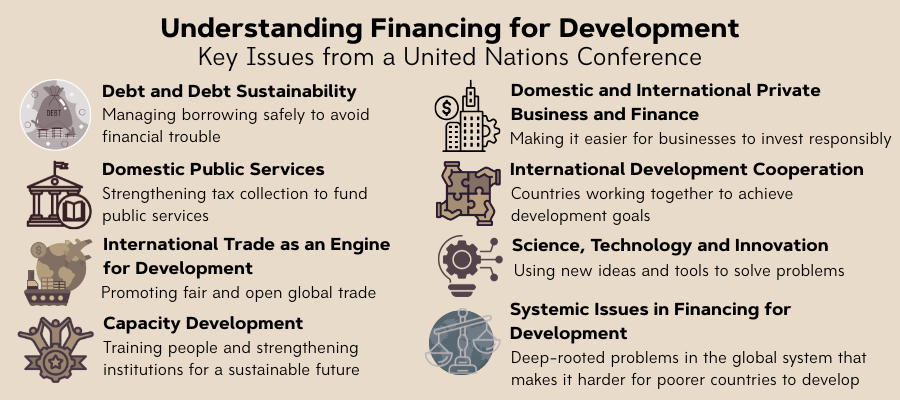
Debt and Debt Sustainability
What it means:
Countries often borrow money to pay for things like schools, roads, and hospitals. But if they borrow too much or cannot repay it, they get into financial trouble.
Why it matters:
When a country is buried in debt, it may have to cut spending on important services like healthcare and education. Debt sustainability means managing borrowing in a way that is safe and does not cause future problems.
Domestic and International Private Business and Finance
What it means:
This refers to money that comes from businesses and investors inside a country (domestic) and from other countries (international).
Why it matters:
Private companies can create jobs, build infrastructure, and invest in industries. The goal is to make it easier and safer for businesses to invest responsibly in development.
Domestic Public Resources
What it means:
This is the money a government collects within its own country, mainly through taxes.
Why it matters:
Governments need this money to provide services like education, healthcare, social welfare, clean water, public transport, salaries for civil service etc. Strengthening tax systems and making sure taxes are fair helps a country rely less on foreign aid.
Internationale Entwicklungszusammenarbeit
What it means:
This includes aid and support from wealthier countries or international organizations to help low-income countries to grow and reduce poverty.
Why it matters:
When countries work together, share knowledge, and support one another, it helps achieve global development goals (SDGs) faster and more fairly.
International Trade as an Engine for Development
What it means:
Trade means buying and selling goods between countries.
Why it matters:
Trade helps countries grow their economies, create jobs, and access goods they do not produce themselves. Fair and open trade systems can help low-income countries compete and benefit more from the global market.
Science, Technology, and Innovation
What it means:
This is about using new ideas, inventions, and tools to solve problems and improve lives.
Why it matters:
From mobile banking to clean energy, science and technology can speed up development and help tackle big challenges like climate change, health crises, and food shortages.
Capacity Building
What it means:
Assisting people, communities, and governments build the skills, knowledge, and systems they need to manage their own development.
Why it matters:
It is not just about giving money—it is also about training people and strengthening institutions so they can create sustainable solutions, take control and be responsible for their future.
Systemic (Structural) Issues
What it means:
Systemic issues are the historical and deep-rooted problems in the way the global financial and economic system were developed and works. These are not just problems in one country or one area—they affect many countries and are built into the way the system was set up.
Why it matters:
Systemic issues matter in financing for development because they are built-in problems in the global financial system that make it harder for poorer countries to access fair opportunities, funding, and support needed for sustainable growth.
Finally, by addressing all these areas and especially the reform of the financial systems, the United Nations hopes to build a more equal, prosperous, and sustainable world where all countries have the tools and resources they need to thrive.
You can download this information below:
Autor: Cecilia O’Dwyer ibvm


