
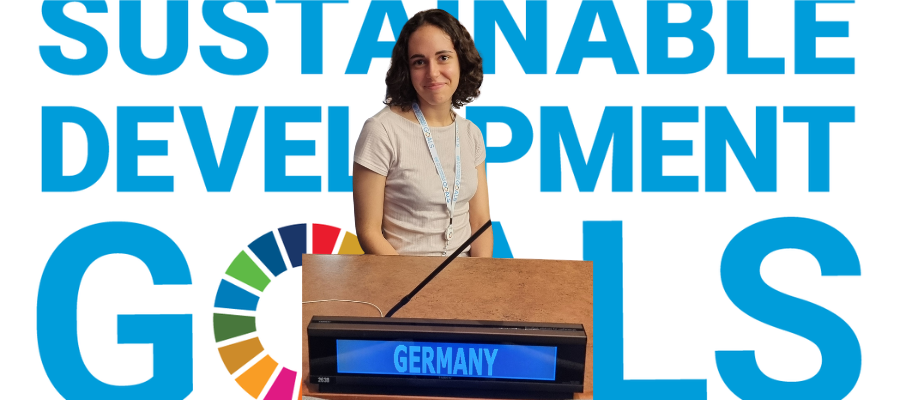
A big part of who I am comes from the women in my family who fled Iran and rebuilt their lives from scratch in Germany. They faced language barriers, cultural differences, and a lack of support — especially as women. Many migrants still face these challenges today.
While progress has been made, these experiences continue to shape my understanding of gender equality and equal opportunity. Though this story is not the main focus of my presentation, it is the reason I care so deeply about justice and inclusion — especially gender equality. Today, I am proud to bring both a national and personal lens to this conversation.
Germany’s 2025 Voluntary National Review, outlines six transformative pathways toward the SDGs — including gender equality, not just in law but in everyday life. The report commits to strong institutions, youth participation, and economic justice. But from my perspective, change is still too slow — and often not reaching the people who need it most.
My Current Reality
I had access to high-quality education at an all-girls school, where I was surrounded by strong female role models — our school leadership was always female. I never personally experienced discrimination — and it showed me the power of safe, supportive environments. But even so, gender inequality is still very much present in my life.
In my own family, women earn significantly less than men — even when they work just as hard. The gender pay gap is more than just a number — it’s a barrier to freedom and a fair future. Even after adjusting for role and experience, women in Germany still earn €1.50 less per hour — a gap that remains unjustified.
In its Voluntary National Review, Germany acknowledges that the gender pay gap is an “Off-Track Indicator” — but offers no clear new solutions. As a student preparing to enter the workforce, I already worry about what awaits me. I do not want to face a future where the same education still means lower pay — just because I am a woman.
I have seen how single mothers in my environment struggle to find housing — not because they are unqualified, but because they are women raising children alone. Their career progress also suffers after childbirth. Part-time work is one reason — but deeper systemic disadvantages play a bigger role.
During my internship in a kindergarten, I noticed that nearly all staff were women — and the wages were low. That is not a coincidence. It reflects a wider truth: women in Germany still carry the burden of care work — and that work is still undervalued and underpaid.
Beyond measurable progress, there is something I — like many girls and women — experience every day: a feeling that is hard to quantify but deeply real — the feeling of not being safe. When I walk home at night and hear footsteps behind me, I cross the street. When I am out with friends, we make sure to look out for one another.
And online, girls learn early on that they are often sexualized, judged, or simply not taken seriously — just for being who they are. You learn to be careful. Sometimes, you even learn to be afraid. These experiences rarely show up in statistics, but they shape our daily lives.
What Would Change if the SDGs Were Achieved?
If the SDGs were fully realized, I would no longer have to worry about earning less just because I am a woman. Women would no longer have to choose between pursuing a career and starting a family. Jobs would be equally paid regardless of gender, and women — especially single mothers —would have equal opportunities in the housing market.
Moreover, every student, both boys and girls, would be taught that gender equality is not something guaranteed but a goal that still requires active effort. This would mean true freedom. Girls would grow up knowing they do not have to depend on a partner, and that their independence is a right, not a luxury.
Globally, we continue to face setbacks. Political shifts — in a number of countries, I do not think I have to name them — have rolled back hard-won rights. That reminds us: gender equality can never be taken for granted.
What Are We Doing in Our Communities?
At my school, I took part in a project supporting girls’ education in Zimbabwe and mentored younger students. These experiences taught me that change starts early — with visibility, encouragement, and access.
As a youth delegate with IBVM, I have learned the power of partnership — across sectors, generations, and countries. But partnerships must be matched with accountability.
I am just one young woman. But my story is shaped by many others — my classmates, my family, and all the women who came before me.
Germany’s Voluntary National Review sets important goals. But if they are to succeed, they must reach us where we live: in schools, clinics, workplaces, and homes. I believe in this vision — but belief is not enough.
We need action. We need courage. And we need honest conversations like the one we are having today.
Read the Summary of Germany’s Voluntary National Review HIER.
Read the Full Voluntary National Review of Germany HIER.
Autor: Lili, CJ Youth Delegate High Level Political Forum


